
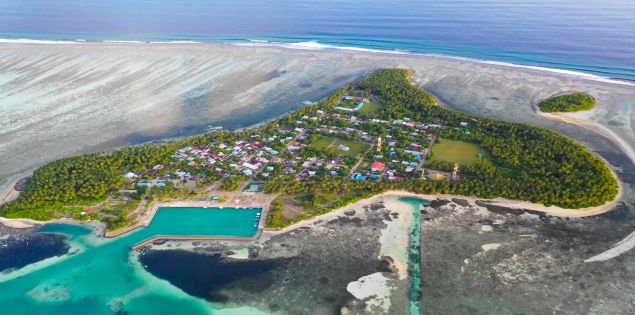
Landscape
Small Island Developing States (SIDS) are on the frontlines of the climate crisis. Despite contributing minimally to global emissions – less than 1% collectively – SIDS face some of the highest costs of climate inaction. Climate change threatens the very habitability of many island nations. The risks range from intensifying tropical cyclones and prolonged droughts to rising sea levels and coral reef degradation. These impacts disrupt not just ecosystems but also significant damage to infrastructure, housing, and agriculture, with annual damages equivalent to 1-8% of the entire GDP. In some Pacific and Caribbean nations, climate-related disasters have caused damages equivalent to double-digit percentages of GDP. For example, Hurricane Maria in 2017 inflicted losses amounting to 225% of Dominica’s GDP.
This stark disparity between minimal emissions and outsized impacts underscores why climate finance is critical for SIDS. While global climate finance is growing, with MDBs delivering a record US $125 billion in climate finance in 2023, only US $2.4 billion, that is under 2% reached SIDS. Additionally, mitigation projects continue to dominate due to clearer revenue pathways, while adaptation, which is essential for the survival of SIDS, remains underfunded and less accessible.
Key concerns
According to the UN’s Standing Committee on Finance, these countries require approximately US $36 billion annually in adaptation finance alone. Adaptation finance needs for SIDS are much higher at 3.4% of GDP annually against the 1.4% required to adapt to climate change by other developing countries
This mismatch is even more stark when considering that adaptation is a public good with limited revenue generation potential. Unlike mitigation projects such as solar farms or energy-efficient buildings that can generate steady cash flows, adaptation efforts – like coastal protection infrastructure and early warning systems – do not necessarily provide direct financial returns. This structural reality makes it difficult to crowd in private investors unless concessional finance, guarantees, or blended finance structures are in place.
Moreover, the challenge isn’t just about the quantity but also about the quality and accessibility of that finance. Many SIDS face structural barriers to accessing global climate funds: small project sizes, limited technical capacity, and complex application processes often delay disbursement or discourage participation altogether. Even when finance is secured, it is frequently in the form of loans rather than grants, adding to already unsustainable debt burdens in economies repeatedly hit by climate shocks. The result is a vicious cycle: climate impacts worsen fiscal stress, which in turn constrains the ability of SIDS to invest in resilience.
Financing resilience in SIDS
Given these constraints, the solution lies in rethinking how climate finance is designed and deployed for SIDS. This means developing mechanisms that are faster, more flexible, and better aligned with the scale and urgency of island realities. Several innovative financial instruments are already paving the way.
One promising example is the use of blue bonds, which raise capital for projects that benefit ocean health and coastal communities. Fiji issued its first sovereign blue bond in 2023, mobilising funds to support sustainable fisheries, coastal protection, and marine ecosystem restoration. Backed by technical assistance from development partners such as the UNDP and aligned with the country’s Sustainable Bond Framework, the bond was designed to attract affordable capital while driving ocean-focused climate resilience. For small island economies deeply tied to marine resources, Fiji’s model illustrates how blue finance can advance both debt sustainability and long-term environmental stewardship.
Another innovative solution is debt-for-climate swaps. These instruments allow SIDS to restructure their debt in exchange for commitments to invest in climate resilience. In 2025, Barbados was chosen as the pilot for a standardised Caribbean debt-for-resilience swap facility. Supported by institutions like the World Bank and Inter-American Development Bank, the facility aims to help Caribbean nations repurchase high-interest commercial debt and replace it with lower-cost, longer-tenure climate-linked debt. The freed-up fiscal space will be redirected to resilience-building efforts such as renewable energy infrastructure, climate-smart agriculture, and community-based adaptation. By simplifying legal frameworks and creating a replicable model, this approach can be extended to other SIDS in the Pacific and Caribbean regions.
Parametric insurance has emerged as a game-changer as a coping mechanism to sudden climate shocks. Unlike traditional insurance, parametric products provide payouts based on pre-agreed triggers like wind speed or rainfall levels – enabling fast disbursements without lengthy claims processes. The Caribbean Catastrophe Risk Insurance Facility (CCRIF) has been a pioneer in this space, providing over US $259 million in payouts since its inception. In 2024, it disbursed US $84 million following Hurricane Beryl, helping member countries respond swiftly without adding to debt burdens. As climate extremes become more common, SIDS in the Pacific are exploring similar pooled insurance models to enhance their financial preparedness.
Together, these instruments reflect a shift toward financing that is not just innovative in form, but also inclusive in function. They are designed to match the scale, vulnerability, and governance capacities of SIDS, helping to unlock capital in ways that support both resilience and sovereignty.
Conclusion
Moving forward, replication and scaling of these mechanisms will require concerted effort. Dedicated SIDS financing windows within multilateral funds like the Green Climate Fund can help reduce transaction barriers. Partnerships with philanthropic capital and guarantees from development finance institutions can de-risk private investment. Regional cooperation through shared insurance pools, technical platforms, and legal frameworks can also drive down costs and build institutional strength. For SIDS, it offers a pathway to turn financial constraints into catalytic investments for a more secure and climate-resilient future.
References:
- https://sdgs.un.org/smallislands/about-small-island-developing-states
- https://sdgs.un.org/sites/default/files/2024-05/ID%203%20Clean%20rev_0.pdf?
- https://climatepromise.undp.org/news-and-stories/small-island-developing-states-are-frontlines-climate-change-heres-why
- https://www.worldbank.org/en/news/press-release/2024/11/30/mdbs-announce-record-climate-finance-of-usd-125-billion-in-2023
- https://www.unep.org/resources/adaptation-gap-report-2024
- https://www.worldbank.org/en/news/feature/2023/03/13/what-you-need-to-know-about-how-ccdrs-estimate-climate-finance-needs#:~:text=Financing%20needs%20for%20climate%20action,as%208.0%25%20in%20low%2Dincome
- https://www.undp.org/pacific/press-releases/launch-fijis-first-ever-sovereign-blue-bond
- https://www.fiji.gov.fj/Media-Centre/News/FIJIAN-SUSTAINABLE-BOND-FRAMEWORK-LAUNCED-AT-COP27
- https://sdgs.un.org/sites/default/files/2024-05/ID%203%20Clean%20rev_0.pdf
- https://www.ccrif.org/