REPORTS
Blended Finance: A viable mechanism for financing energy transition in developing countries
Practical model bringing together private and public capital in a risk-adjusted return structure
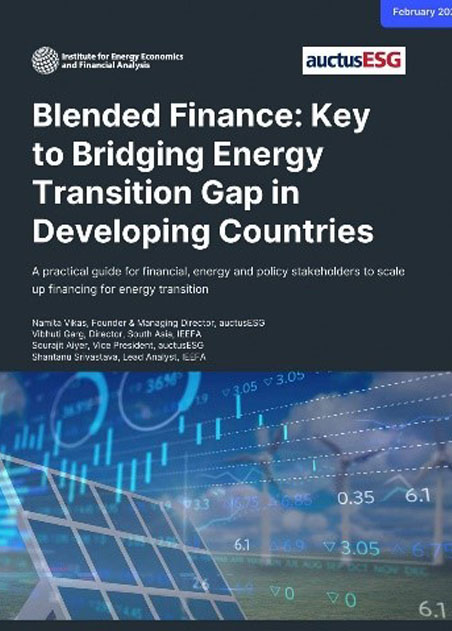
The report “Blended Finance: Key to Bridging Energy Transition Gap in Developing Countries”, developed by auctusESG and IEEFA, makes a strong case for the use of blended finance as a pivotal mechanism to support clean energy transitions in emerging economies. It draws attention to the financing gap that persists for small and socially impactful energy projects, particularly in communities that remain underserved. While large-scale solar and wind projects have successfully attracted commercial capital, many decentralised and inclusive energy solutions continue to be overlooked. The report argues that this is largely due to the misalignment between commercial risk-return expectations and the developmental aims of energy access. Blended finance provides a means to bridge this gap by combining public and private capital in a structured manner that mitigates risk and allows such projects to be aggregated at scale.
The report goes beyond a simple definition of blended finance and explores it as a customisable approach that aligns capital structures with local contexts, project risks and developmental priorities. It highlights the use of catalytic capital from public sources and philanthropies to crowd in commercial finance. Instruments such as concessional loans, guarantees and interest subventions play a key role in de-risking investments and attracting private participation. The report makes clear that blended finance is not appropriate for every project, but it is particularly suited to sectors where financial models are still evolving or where the social benefits outweigh immediate financial returns. The example of solar mini grids in India illustrates this point effectively, as these systems provide clean and reliable power to remote areas but face challenges in scaling due to high capital costs and limited investor confidence.
As a practical guide, the report outlines the considerations necessary for structuring successful blended finance mechanisms. It presents checklists and decision-making frameworks for financiers, policymakers and developers, with a particular emphasis on ensuring that energy transition financing also supports a just and fair outcome. This includes recognising the needs of low-income populations, the importance of community engagement and the requirement for long-term project viability. By drawing from India’s experience and offering insights applicable to other developing countries, the report presents blended finance not only as a tool for scaling energy access, but also as a path to building inclusive, climate-resilient economies.
SDG ALIGNMENT